
Author: Prof. Sebastián A Chiapella
Colegio Schönthal A-581
Av. Nazca 537 – Ciudad de Buenos Aires – Argentina
Tel: 4637-1414
correo@schonthal.esc.edu.ar
www.schonthal.esc.edu.ar
A Natural Sciences workshop with sixth-grade students made it possible to see how knowledge can turn fear into curiosity, and curiosity into respect. Through the observation of small arthropods, the students discovered that understanding living creatures can also help us understand people better.
Abstract
Many of the reactions we have toward the unknown respond more to fear than to real understanding. This article describes a Natural Sciences workshop developed with sixth-grade students, in which the direct observation of small arthropods, collected by the students themselves and examined with magnifying glasses, entomological specimen boxes, and a digital microscope, made it possible to turn an initial rejection of these organisms into genuine curiosity and, ultimately, into respect. Beyond the biological content it covered, the experience opened up a broader reflection: the idea that getting to know something before judging it is also the path toward relating better to people. The article proposes that science education, when built on observation and direct experience, can become a powerful tool for fostering values such as respect and empathy.
The Fear That Comes Before Understanding
What do most kids do when they find a spider, an ant, or any other «bug» in their house? The answer tends to be the same, again and again: kill it, not out of cruelty, but because from a very young age they learned that whatever they don’t understand represents a danger. This workshop was born from exactly that reality; my intention wasn’t only to teach Biology content, but to explore how fear so often arrives before understanding, and how, once we learn to truly know whatever is in front of us, the way we act changes completely. I chose to work with arthropods because they’re an everyday example of 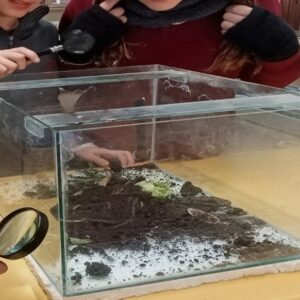 how we tend to form prejudices before we understand.
Before going into the lab, I met with the students in the classroom and asked them a very simple question: what do you do when you find a bug in your house? The answers came immediately: we kill it. When I asked why, they all agreed on the same reasons: it scared them, and they thought it might bite or sting them. That was when the real question appeared, the one that gave rise to the entire workshop: but do you actually know it? Do you know how it lives, what it eats, or whether it can really hurt you?
The silence that followed was the beginning of a different way of looking at nature.
The Challenge of Searching Without Harming
I proposed a challenge: over the following days, they would need to look for small arthropods in their homes, gardens, or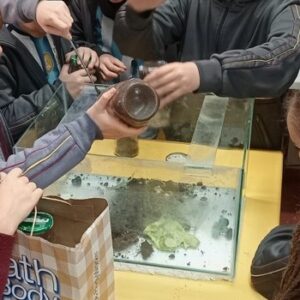 nearby green spaces, always respecting the creature’s life. I taught them how to capture them without hurting them, how to prepare containers with ventilation and substrate to transport them, and how to handle them with care. Some students admitted they didn’t feel brave enough to touch them, and there was no need to push them; they could just as easily take part by preparing containers or helping their classmates. What mattered was that everyone was part of the experience.
On the day of the workshop, the lab filled with excitement; each student arrived carefully holding the small container where they’d transported the creatures they’d found. They no longer looked at them with fear; now they wanted to find out what they were.
We gathered all the specimens in a large terrarium and began the observation. Using small brushes and magnifying glasses, they separated the soil with enormous care so as not to harm the animals, and very soon the first questions appeared. Why does this one have antennae? Why does that one have 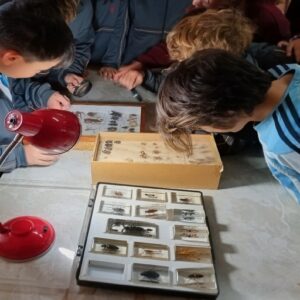 eight legs? Are they all the same?
Without even realizing it, the students had stopped asking themselves whether these creatures should be killed. Now they wanted to understand them, and that, precisely, was the workshop’s first objective.
When the «Bug» Started to Have a Name
The experience continued around the lab’s entomological specimen boxes, where the students could compare the specimens they’d collected themselves with others that were perfectly preserved and identified. What just minutes earlier had simply been a «bug» now began to take its place within a biological group with characteristics of its own.
The comparisons came up spontaneously: they counted legs, looked for antennae, told insects apart from arachnids, noticed the differences between a spider and a scorpion, compared a pill bug with other crustaceans, and discovered that organisms which looked very similar actually belonged to completely different groups. Every new specimen sparked new questions, and every answer led to a new observation.
Biology stopped being a list of concepts and became a living experience. They weren’t observing simply because I asked them to; they were observing because they wanted to discover more.
What the Microscope Revealed
The next step was to bring the group back together around the 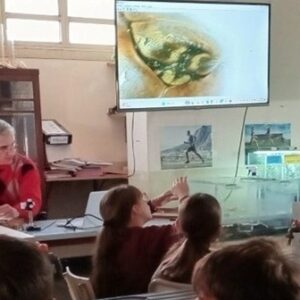 digital microscope connected to the lab’s television screen. One by one, we placed the very arthropods the students had brought in under the lens, and the magnified image revealed an entirely new world: legs, eyes, antennae, and mouthparts appeared projected in a level of detail that sparked enormous enthusiasm.
That was when they began to question some of the ideas and fears they had arrived with. Looking closely at the mouthparts, they understood that the arthropods we typically find in our homes have very different characteristics from one another, and that the mere presence of an arthropod does not necessarily pose a risk to people. What had been a source of fear for years was starting to become a source of admiration.
The questions kept coming, one after another. Where do they live? Why do some come out at night? Why do they hide when we shine a light on them? Every answer opened a new conversation, and every conversation reinforced an idea that kept growing throughout the whole activity: that understanding is always worth more than reacting out of fear.
At that point I shared a reflection with them that shifted their perspective once again. We often think these animals are invading our space, but the reality is exactly the opposite: we’re the ones who built our cities, our houses, and our gardens on top of environments where they were already living, long before us. They’re simply trying to adapt to a world that we changed. Understanding that also means learning to respect them.
From Arthropods to People
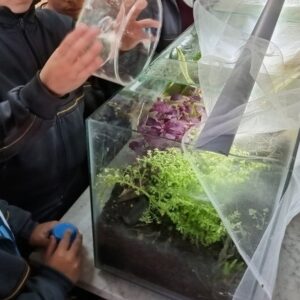 The activity ended the same way it had begun, with respect. All the arthropods were carefully placed back in the lab’s terrarium to continue living in a suitable environment. After observing them, studying them, and getting to know them, returning them to that space became a natural gesture for the students themselves.
Before wrapping up the workshop, we returned to the question that had started everything. I explained to them that the real goal had never been simply to learn about arthropods; what mattered was understanding that before passing judgment on any living creature, we first need to get to know it. From that experience, we carried the reflection over into our relationships with other people: we can also ask ourselves how much of our judgment is built on what we actually know, and how much on our own ideas or fears.
In our everyday relationships, too, we can reject, criticize, or push someone aside without ever giving them the chance to show who they really are. Perhaps if we took the time to get to know them first, we might discover a reality quite different from the one we’d imagined.
The students went back to their classrooms with new knowledge of Natural Sciences, but also with a lesson that reached far beyond the lab. That morning, they began by observing small arthropods, and they ended up reflecting on how knowledge can become a path toward respect for the different forms of life.
References
Shahriari-Namadi, M., Tabatabaei, H. R., & Soltani, A. (2018). Entomophobia and arachnophobia among school-age children: A psychological approach. Shiraz E-Medical Journal, 19(7), e64824. https://doi.org/10.5812/semj.64824
Soga, M., Gaston, K. J., Yamaura, Y., Kurisu, K., & Hanaki, K. (2016). Both direct and vicarious experiences of nature affect children’s willingness to conserve biodiversity. International Journal of Environmental Research and Public Health, 13(6), 529. https://doi.org/10.3390/ijerph13060529
Li, Y., Zhao, Y., Huang, Q., Deng, J., Deng, X., & Li, J. (2024). Empathy with nature promotes pro-environmental attitudes in preschool children. PsyCh Journal, 13(4), 598–607. https://doi.org/10.1002/pchj.735
Allport, G. W. (1954). The nature of prejudice. Addison-Wesley Publishing Company.
Musengimana, J., Kampire, E., & Ntawiha, P. (2022). Effect of inquiry-based learning on students’ attitude towards learning biology at upper secondary schools in Rwanda.
Journal of Baltic Science Education, 21(5), 862–874. https://doi.org/10.33225/jbse/22.21.862
Wilson, E. O. (1984). Biophilia. Harvard University Press. https://doi.org/10.4159/9780674045231