
Author and photos: Prof. Sebastián A Chiapella
Colegio Schönthal A-581
Av. Nazca 537 – Ciudad de Buenos Aires – Argentina
Tel: 4637-1414
correo@schonthal.esc.edu.ar
www.schonthal.esc.edu.a
An experience with Zophobas morio to ask what happens to what we discard
Abstract
What happens to the things we no longer need and call waste? This question gave rise to a laboratory experience with first-year “A” Biology students at Colegio Schönthal, in Buenos Aires City, Argentina. The starting point was an everyday material, expanded polystyrene (EPS), commonly known as Telgopor in Argentina, and an organism capable of interacting with it: Zophobas morio larvae. Over approximately one month, the students organized the larvae according to their initial mass, established comparable groups, and observed what happened when they received oats or EPS as feeding material. The experience made it possible to observe visible changes in the polystyrene and record variations in larval mass, but it also showed the importance of distinguishing between what we can observe and what we can scientifically claim. Beyond the experiment itself, the work opened up a question that ultimately became more important than the EPS itself: if something ceases to be useful to us and we call it waste, does it really cease to be part of the environment?
A Question That Started with a Television
The conversation began with a simple question:
What happens to the things we use for a while and then no longer need?
One of the students told us that when his family bought a new television, the set arrived protected by large pieces of EPS. Once it had been installed, that material was no longer of any use to them. They took it outside and left it next to the rubbish bin.
The next day, when the student left his house, the EPS was no longer there. “And where did it go?” I asked. The student shrugged and said:
“I don’t know, teacher. It disappeared.”
The answer caught my attention because, for the student who had left the EPS next to the rubbish bin, it had effectively disappeared. It was no longer there, he could no longer see it, and from his perspective, the thing he had discarded had simply ceased to be there. But the material had not really disappeared; it had simply ceased to be in front of his eyes.
From that situation emerged an idea that would later become the central theme of the entire experience. The word “waste” does not describe an intrinsic property of a material, but rather a category that we construct from our relationship with it. If something ceases to be useful to us, we discard it and turn it into waste. The problem is that this change occurs for us, not necessarily for the environment.
The question remained open and, a few days later, resurfaced in the laboratory.
Bringing the Question into the Laboratory
I had decided to work with Zophobas morio larvae, commonly known as superworms, which can be purchased from pet stores as food for reptiles. I bought two containers with approximately one hundred larvae each and brought them to the laboratory. I did not want to begin by explaining to them what they were supposed to discover. I preferred that we first have a concrete problem to solve.
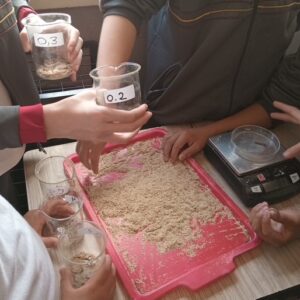 I gathered the students around a large table and placed the approximately two hundred larvae in a tray. The first thing they observed was that they did not all have the same mass. If we wanted to compare what happened to those that would receive EPS with what happened to those that would receive oats, we needed to form groups that were as comparable as possible.
We then took an electronic balance and began weighing the larvae one by one. Each student recorded the measurement. We then looked on the laboratory shelves for small beakers in which to classify them. Each larva was placed in the container corresponding to its mass. As the students formed groups around 0.2, 0.3, and 0.4 grams, the small differences between some of the measurements became visible, so we used these values as reference masses for organizing the groups, without intending all the individuals to be identical.
At the same time, other students were preparing the labels with the references for the next stage of the experiment.
Once we had finished the classification, we selected the groups that allowed us to have ten larvae for each condition. We then went back to the shelves to look for containers with greater capacity. The final setup consisted of six experimental groups, each containing ten larvae: two 600 cm³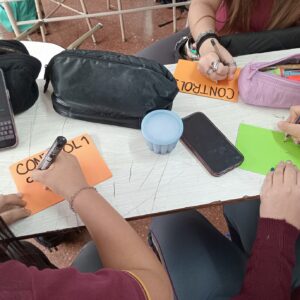 beakers and four crystallizing dishes. For each of the three reference masses, we established one group that would receive oats and another that would receive EPS.
We placed approximately one centimeter of oats or EPS in the containers, as appropriate, and all groups received a small amount of water daily using a spray bottle. The students prepared the labels, organized the containers, and began recording what happened.
From that moment on, the laboratory changed. It was no longer simply a matter of observing some larvae; we had to wait, compare, record, and look again.
When the EPS Began to Change
As the days passed, the EPS began to show visible changes. The pieces became thinner, 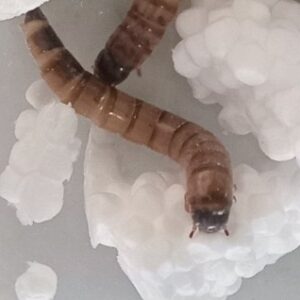 increasingly smaller fragments appeared, and in some containers we could observe white material with a powdery appearance. It was then that one of the students pointed to the container and asked:
“Teacher, look what happened to the EPS. Are they eating it?”
The question was exactly the one we needed. I explained that we still could not know for certain. The fact that the material had become fragmented or had a different appearance showed that a change had occurred, but it did not by itself allow us to determine what process had produced it. Fragmentation is not necessarily ingestion, and ingestion does not by itself demonstrate that complete biodegradation of the polymer has occurred.
Scientific literature had already documented that larvae of the genus Zophobas can consume polystyrene and that microorganisms associated with their digestive system may participate in its transformation, although these processes require analytical methods that were not available in our school laboratory (Peng et al., 2020; Yang et al., 2020; Sun et al., 2022). A more recent review also brings together evidence on the aging and biodegradation of polystyrene-based materials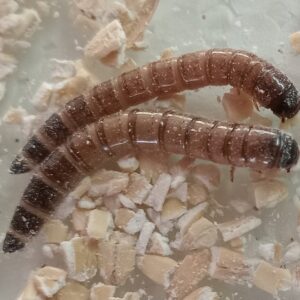 (Dong et al., 2024).
For us, this information was important, but not to turn it into an answer in advance. On the contrary, it allowed us to understand that our observation was part of a broader scientific question.
Looking at the Larvae Too
While we were observing the EPS, we also monitored the organisms. At the end of approximately one month of the experiment, we removed the larvae and weighed them individually again using the electronic balance.
The results were heterogeneous and did not show a single trend. In the group organized around 0.2grams, some of the most marked decreases were observed, although some final measurements were also slightly higher. In the 0.3grams and 0.4grams groups, many of the measurements remained relatively close to the initial masses, with small variations both upward and downward. Because the larvae had not been individually marked during the observation period, we could not 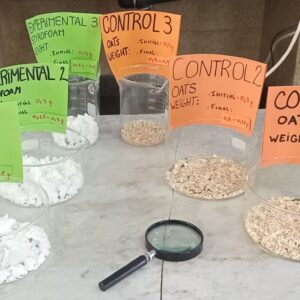 relate each final measurement to a specific individual. Nor could we directly attribute a change in mass to the consumption of EPS. What we could say was simpler: the masses recorded at the end were not identical to the initial ones, and there were differences among the measurements.
For this reason, the experience had an exploratory character. We did not have independent replicates for each condition, nor did we have a container with EPS but without larvae that would have allowed us to distinguish changes produced by the organisms from those that might have been due to other factors. If we wanted to investigate the question further, these would be some of the aspects we would need to improve.
But there was something else changing in the school laboratory as well. At first, several students approached the larvae with a certain degree of distance. As the days went by, they began to observe them more closely, distinguish differences between them, record their movements, and discuss what might be happening inside the containers. The organism that at the beginning was simply a larva that had to be handled carefully had become part of a question they themselves were trying to solve.
When the Waste Appeared Again
The experience ultimately brought the conversation back to where it had begun: our own practices.
What do we do when something is no longer useful to us? What does it really mean to “throw something away”? What happens to that object after it leaves our home, our school, or simply passes out of our sight?
The students began to mention everyday situations. Some said that at home they separated paper and cardboard, bottles, or certain types of waste. Others explained that everything ended up together because it was easier. The conversation was not intended to assess who recycled correctly or to turn the experience into an environmental campaign. What mattered was that they could now look differently at an action we normally carry out almost without thinking: discarding.
At that moment, the memory of the television naturally returned to the conversation. The student who had told that story recognized the EPS we were using in the laboratory and said something that, for me, summarized much of what we had learned:
“Teacher, the EPS I threw away didn’t disappear either. It must be somewhere else. Maybe it could even have been useful for something, like it is here with the Zophobas.”
We were not demonstrating what had happened to that particular piece of EPS. Nor could we claim that plastic waste in general can become a resource for another organism. But the student’s reasoning had changed. “It disappeared” was no longer a sufficient answer.
The experience with Zophobas morio did not teach us how to get rid of EPS either, but it allowed us to understand something more important: what we call waste does not stop being part of the environment when we discard it and, under certain conditions, may even enter transformation processes mediated by other organisms. Perhaps that is one of the most necessary questions we can bring into a school laboratory, not only what a larva can do with a material that we consider useless, but what happens when an object ceases to have value to us. Because perhaps the challenge is not only to learn how to dispose of things better, but to learn to look again at what everyday life has taught us to stop looking at. And perhaps that is one of the most valuable contributions of Biology education.
Learning to look again at what everyday life has taught us to stop looking at.
References
Dong, D., Guo, Z., Yang, X., & Dai, Y. (2024). Comprehensive understanding of the aging and biodegradation of polystyrene-based plastics. Environmental Pollution, 342, 123034. https://doi.org/10.1016/j.envpol.2023.123034
Peng, B.-Y., Li, Y., Fan, R., Chen, Z., Chen, J., Brandon, A. M., Criddle, C. S., Zhang, Y., & Wu, W.-M. (2020). Biodegradation of low-density polyethylene and polystyrene in superworms, larvae of Zophobas atratus (Coleoptera: Tenebrionidae): Broad and limited extent depolymerization. Environmental Pollution, 266(1), 115206. https://doi.org/10.1016/j.envpol.2020.115206
Sun, J., Prabhu, A., Aroney, S. T. N., & Rinke, C. (2022). Insights into plastic biodegradation: Community composition and functional capabilities of the superworm (Zophobas morio) microbiome in styrofoam feeding trials. Microbial Genomics, 8(6), mgen000842. https://doi.org/10.1099/mgen.0.000842
Yang, L., Liu, Y., Gao, J., Peng, X.-W., Bai, Z.-H., & Zhuang, X.-L. (2020). Biodegradation of expanded polystyrene foams in Zophobas morio: Effects of gut microbiota. Huan Jing Ke Xue, 41(12), 5609–5616. https://doi.org/10.13227/j.hjkx.202003273
Yang, Y., Wang, J., & Xia, M. (2020). Biodegradation and mineralization of polystyrene by plastic-eating superworms Zophobas atratus. Science of the Total Environment, 708, 135233. https://doi.org/10.1016/j.scitotenv.2019.135233