
Author and photos: Sebastian Chiapella
An observation that arose out of everyday experience led a group of teenagers into the laboratory to observe, compare, and learn more about the foods that are part of their choices.
Abstract
What do we really know about the foods that are part of our everyday choices? This question gave rise to a laboratory experience carried out with 30 second-year A students, aged between 14 and 15, at Colegio Schönthal, in the Autonomous City of Buenos Aires, in which the students brought to the laboratory the foods they had eaten during one full day, freely chosen within a weekend or a day off, and analyzed them in two stages: first the ultra-processed products, then the fresh foods. As the experience progressed, these foods stopped being simply what each student was used to eating and also became objects of observation and knowledge, sparking questions and conversations that, in the days that followed, continued spontaneously. The experience showed a concrete way of approaching food education from school: generating knowledge from everyday situations and giving students more elements to think through their own choices.
A Question About Food Choices
It was a Saturday afternoon, at the club where I do sports, while I was waiting for my coffee at the snack bar, when something caught my attention: in front of me, a group of teenagers was choosing between different foods, some went for fruit or yogurt, others for alfajores, potato chips, or soft drinks, and as I watched them, I began wondering how much they actually knew about what they were choosing.
The scene raised a question: what do teenagers actually know about the foods that are part of their everyday choices? The interest wasn’t in determining which foods were better or worse, but in finding out what information the students had about what they chose to eat.
Adolescence is an important stage for shaping food preferences, a period in which autonomy over these decisions also increases, along with exposure to the different settings in which they take place (WHO, 2026; Shaw et al., 2023). From the standpoint of food education, everyday situations can become learning opportunities: the FAO highlights the value of contextualized, participatory experiences, and various interventions have shown that working with nutrition labels can improve their comprehension (FAO, n.d.; Moore et al., 2018; Rana et al., 2025). But knowing doesn’t necessarily mean changing; the evidence indicates that the relationship between nutritional knowledge and eating behavior in adolescents is neither direct nor, on its own, sufficient to explain the choices that follow (Thakur & Mathur, 2022).
For that reason, the experience wasn’t designed to establish which foods the students should choose, nor to classify foods as «good» or «bad.» Its purpose was to broaden knowledge about the diversity of foods and create a space where each student could express their preferences and compare alternatives.
With that idea in mind, we decided to bring the question into the Biology laboratory.
When the Food Arrived in the Laboratory
The experience took place in the Biology laboratory at Colegio Schönthal. Thirty second-year A students, aged between 14 and 15, took part; they had already covered content on the composition of food: carbohydrates, proteins, lipids, and vitamins.
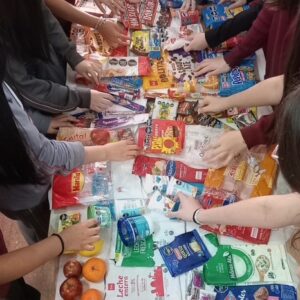 The instructions were simple: they were to pick a full day, as they chose, within a weekend or a day off, and bring to the laboratory the foods they had eaten that day, from the moment they woke up until they went to sleep, whatever the food happened to be. No specific foods or categories were set in advance for them to represent.
In the next class, the lab benches filled up with food, predominantly ultra-processed products such as alfajores, chocolate, and potato chips at first, along with other, less processed items. When the same product was brought in by more than one student, it was recorded only once, since the goal was to gather as wide a variety of foods as possible for observation and comparison. The students organized themselves into three groups, and we decided to proceed in two stages within that same class: first the ultra-processed foods,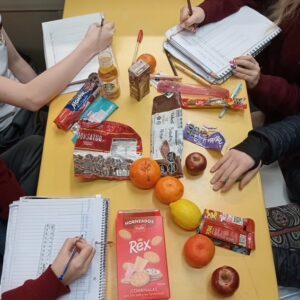 and later the rest.
The first instruction was simply to observe. They looked at the products and their packaging, turned the packages over to find the nutrition labels, grouped similar products together — cookies with cookies, alfajores with alfajores, potato chips with potato chips — and recorded in their notebooks the data they found: calories, protein, fat, carbohydrates, fiber, vitamins, and sodium.
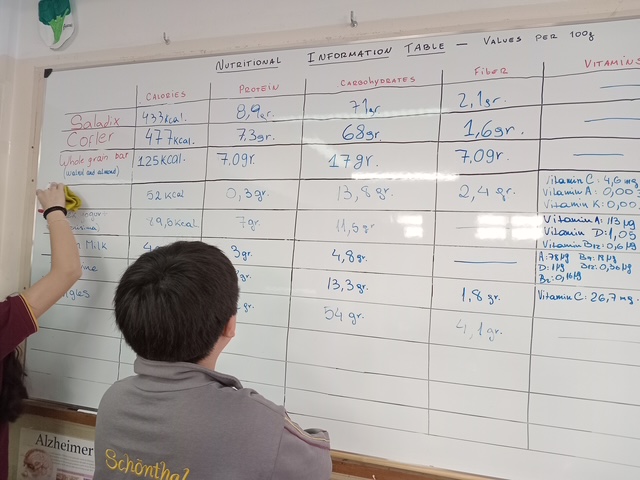
The information from the three groups was then brought together as a class: the data went up on the board, and a shared table took shape, with values expressed per 100 grams whenever the available information allowed it. When a piece of data didn’t appear on the packaging, we consulted SARA 2, the Table of Chemical Composition of Foods for Argentina, produced by the National Ministry of Health (Elorriaga et al., 2022); if it couldn’t be reliably found, the corresponding space was left blank. The table wasn’t meant as a statistical sample, but had a purely educational purpose: to bring together and make visible the information available on the specific foods the students had brought in, so it could be observed, compared, and discussed.
Once the analysis of the ultra-processed foods was complete, we turned to the other foods brought in that same day: apples, bananas, avocado, potato, tomato, lettuce, grapes, squash, eggs, yogurt, milk, bran bread, cream cheese, fresh cheese, and meat. The benches filled up again, and the students worked with the same categories from the table. The intention wasn’t to replace one set of foods with another, but to widen the range in front of them, so they could observe and compare a broader diversity.
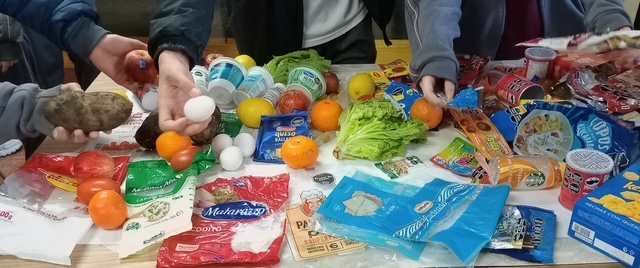
With the table finished, the students set their notebooks aside for a few minutes and looked at everything laid out in front of them. It was no longer just about recording data; they began connecting the foods to their own experiences: some mentioned that they usually ate bananas or apples; others said they preferred cookies or alfajores because those were what they liked best. Some considered alternating different foods throughout the week; others preferred to stick with their usual choices. There was no single response, and that, precisely, was what made it interesting.
Looking at Food in a Different Way
The experience made it possible to observe something central: having access to information doesn’t necessarily mean everyone responds to it the same way. The students took part in the same activity and looked at the same type of information, yet each of them connected what they observed to their own preferences and experiences, something consistent with the available evidence on food choices during adolescence (Shaw et al., 2023). The literature on educational interventions involving nutrition labeling, for its part, points out that these experiences can improve understanding of the information, even though that knowledge doesn’t necessarily determine later changes in food choices (Moore et al., 2018; Rana et al., 2025).
Nor would it be methodologically valid to claim that the experience changed the students’ choices: there was no pre- and post-intervention assessment, no comparison group, and no systematic follow-up. But that was never the goal. The aim was for students to pause in front of foods that were part of their everyday lives, observe them more closely, and talk about their own choices. The laboratory worked as a space where an everyday choice could become, at least for a few hours, an object of knowledge. It wasn’t about telling them what to choose; it was about knowing more.
When the Conversation Continued
In the days that followed, comments began coming up spontaneously about the foods the students had chosen at different times. On one such occasion, a student said:
«Teacher, today I brought fruit to eat. I’m not going to eat cookies all morning; I’d rather have some fruit and then, maybe, have some cookies afterward.»
Others mentioned they had chosen yogurt and oats, while some said they were sticking with donuts, cookies, or chocolate because those were the foods they preferred. These situations weren’t recorded through any assessment tool, so they don’t allow us to conclude that the experience changed the students’ food choices. Still, one thing stood out in particular: the topic kept coming up spontaneously, without the teacher ever bringing it up again.
The work was over; the food had been cleared off the benches; and the table on the board was no longer part of the activity. And yet, some students kept talking about what they ate, what they preferred, and other possibilities they now recognized. That may be one of the most meaningful things the experience left behind. Not every student reacted the same way, nor did they need to. What mattered was that, at least in some cases, the experience opened up a new conversation around those choices, new questions, new comparisons, and new possibilities.
It isn’t the school’s job to choose for teenagers; its responsibility is to give them the knowledge that lets them understand the world around them and build their own judgment. In this case, the laboratory allowed a food choice to stop being just a habit and become, as well, a thought-out decision.
Because knowing doesn’t force change, but it does widen the possibilities. And when a teenager discovers that they have more than one option to choose from, perhaps teaching has already fulfilled an essential part of its task.
References
Elorriaga, N., Figueroa, G., Mangialavori, G. L., Romero, I. B., Rovirosa, A. B., & Tenisi, M. S. (2022). SARA 2: Tabla de composición química de alimentos para Argentina. Compilación para ENNyS 2. Ministerio de Salud de la Nación.
Food and Agriculture Organization of the United Nations (FAO). (n.d.). School-based food and nutrition education. Food and Agriculture Organization of the United Nations.
Moore, S. G., Donnelly, J. K., Jones, S., & Cade, J. E. (2018). Effect of educational interventions on understanding and use of nutrition labels: A systematic review. Nutrients, 10(10), 1432. https://doi.org/10.3390/nu10101432
Rana, T., Konapur, A., Mishra, P., Kour, M., Rao, A., Arora, M., & Gavaravarapu, S. M. (2025). The impact of educational interventions on food label comprehension and food choices among adolescents: A scoping review. BMC Public Health, 25, 2682. https://doi.org/10.1186/s12889-025-23940-5
Shaw, S., Barrett, M., Shand, C., Cooper, C., Crozier, S., Smith, D., Barker, M., & Vogel, C. (2023). Influences of the community and consumer nutrition environment on the food purchases and dietary behaviors of adolescents: A systematic review. Obesity Reviews, 24(7), e13569. https://doi.org/10.1111/obr.13569
Thakur, S., & Mathur, P. (2022). Nutrition knowledge and its relation with dietary behaviour in children and adolescents: A systematic review. International Journal of Adolescent Medicine and Health, 34(6), 381–392. https://doi.org/10.1515/ijamh-2020-0192
World Health Organization (WHO). (2026). Healthy diet. World Health Organization.